QCVISUAL
  • HOME
  • PORTFOLIO
  • eLearning
  • ABOUT
  • CONTACT

WCH-OPEN eLearning Module

Understanding Depression in Eating Disorders: Identification, assessment & management of anorexia nervosa

BACKGROUND

In Canada, problems currently exist concerning patient access to mental health services. Simply adding additional providers is not a sustainable solution. Instead, it is important to build capacity through the development of continuing professional education and health system interventions to support mental health care providers and enable them to provide up-to-date care.

The Online Psychiatric Education Network (OPEN) will provide eLearning opportunities for health professionals, patients and their families.

The Online Psychiatric Education Network (OPEN) at Women’s College Hospital and the Visual Knowledge Building & Translation (vKBT) Lab in Biomedical Communications at the University of Toronto have developed a shared vision and partnership to create OPEN. 

To learn more about the OPEN project, go to the WCH-OPEN website.
Picture
Picture
Picture
To see the eLearning module on anorexia nervosa, click the button below.
OPEN MODULE

PROJECT

I developed the first eLearning module to pilot the OPEN initiative, based on my Master's Research Project animation for the Biomedical Communications program at the University of Toronto.

​The learning objective of the course is to help family physicians understand the linkages between depression in anorexia nervosa and the necessity of eating for wellness. 
Title:

​Team Members:


Audience:

Format:

Software:
Understanding Depression in Eating Disorders: Identification, assessment & management of anorexia nervosa

Dr. Shelley Wall, Dr. Seena Grewal (SickKids), Dr. Richelle Twose, Dr. Leila Lax, Dr. Valerie Taylor, Dr. Sanjeev Sockalingam, Dr. Renu Gupta, Dr. Robin Mason

Family physicians. (Note: original animation audience was for Adolescent eating disorder patients and their families at SickKids. Editing of animation was prohibited). 

eLearning module with online assessment, graphic narrative with interactive knowledge translation tips, 3-5 minute 2D/3D animation

​Videoscribe, Autodesk Maya, Autodesk Mudbox, Adobe Photoshop, Illustrator, After Effects, and Audition

 PATIENT CASE STUDY - GRAPHIC NARRATIVE

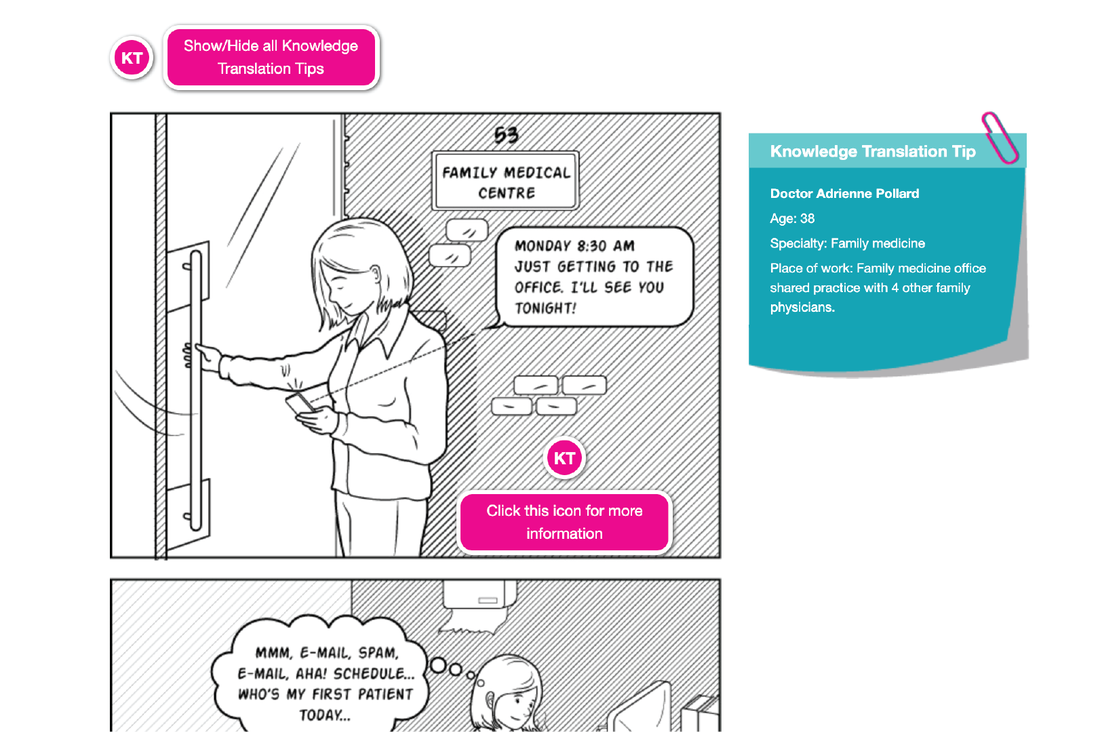
A graphic narrative approach was developed to simulate an appointment experience for the case study. Medical comics is an emerging trend and genre of medical literature. It offers a unique, visual, and interactive way to narrate the patient experience and doctor-patient interaction, as well as illustrate underlying thoughts and assumptions. This format is cost-effective in lieu of high-budget video production with actors. It also visualizes key clinical indicators to note during the appointment, such as body language, facial expressions, and non-verbal cues. The learning effectiveness of this format is augmented through interactive knowledge translation tips interspersed throughout the graphic narrative.
Graphic narrative panels and slides simulate conversations and doctor-patient interactions.
Body language, facial expressions and other non-verbal cues are highlighted.
Interactive knowledge translation tips show key information or clinically relevant indicators.

PHYSICIAN &  PATIENT EDUCATION - 2D/3D ANIMATION

An eating disorder (ED) is a psychological illness characterized by abnormal eating behaviour and thoughts about body shape and weight. When admitted to treatment centers, patients with EDs are often suffering from malnutrition and lack essential nutrients needed for neurotransmitter serotonin (5-HT) production. 5-HT insufficiency plays a major role in the depressive, anxious, and obsessional symptoms commonly seen in ED patients. Intake of selective serotonin reuptake inhibitors (SSRIs) is the preferred pharmacological treatment method. However, unless nutrition status is restored, SSRIs will lack efficacy, as the body cannot produce enough 5-HT when in a state of starvation. Therefore, it is essential that patients with EDs and their families understand that the key to successful treatment of depressive symptoms is nutrient restoration achieved through adherence to meal plans. 
​
However, there is a significant lack of patient education (PE) resources in the field of EDs. A telephone survey conducted in preparation for this project showed that 11 of the major ED treatment centres in Canada have no PE resources in educational modules on this topic or enough PE resources in general. Furthermore, existing PE resources are inadequate in that: (1) they are verbal and written text only; (2) they lack audio and visual material; (3) the few videos available are outdated by 10-20 years; (4) they do not address the cognitive challenges faced by ED patients; (5) and the information is not easily understandable to a general audience. 

Therefore, for my master's research project (MRP), I created a 2D/3D animation for use in the initial information session at the SickKids ED treatment program to educate adolescent patients and their families on the link between nutrition, 5-HT, depression, and treatment. This project was the first of its kind in the biomedical communications field and is a starting point for the development of future PE resources for ED treatment. It is now also in use at the Credit Valley Hospital ED treatment center for adults. 

Due to the lack of PE materials in the ED field, the significant relevancy of the topics covered, and the ease of understanding of information presented by a general audience, the animation was included as an additional resource in the OPEN eLearning Module. 
To learn more about the OPEN project, click the button below.
WCH-OPEN Website

Services

Medical Illustration
Graphic Design
Animation
Scientific Illustration

Pages

Home
Portfolio
About

Contact
QCVisual medical illustration logo
  • HOME
  • PORTFOLIO
  • eLearning
  • ABOUT
  • CONTACT